Monday, April 25, 2016

Life in a Rich Man's World When You Fit Neither of Those Criteria (But I Have Money Now)

I don’t think many people, including the ones struggling, realize what a burden it is to not have money. The kind of stress it puts on every little decision you make: weighing your options, trade-offs, compromises – it’s exhausting. But you get used to it. You convince yourself that it’s universal. Of course people who buy themselves nice things have to withstand losses in every other part of their life. Sure, I’m supergluing my boots together because I can’t afford to spend even $20 on a cheap new pair, but it’s just because I’m not willing to live off plain noodles and toast for the weeks before my next paycheck.

It’s a choice. But it’s a choice that’s embarrassing and one that sucks to have to make.

Growing up we didn’t get an allowance. It wasn’t until I was 16 and had my own paycheck that my parents started offering $1 for every time we washed the dishes. Asking my parents for money was the most stressful thing I can remember from middle school. When my mom took me shopping, she would politely redirect me to the clearance rack if I ever dared look at something full price. I’d ask to go to a movie with my friends and my dad would respond “And how are you paying for that?” Then I’d politely ask if I could have $10, he would begrudgingly hand me his wallet, and I would hope he only had a $20 bill and would forget to ask for his change.

Even before I wanted to spend money independently, I was acutely aware of my family’s financial situation. One of the reasons I clung so hard to the idea of Santa Clause and was so devastated upon discovery of the lie was that it was the only time I could ask for what I wanted free of guilt. I joke now about my insistence on his existence, but the truth is Christmas was never the same. Once I knew my parents were funding my Christmas, I limited my list to only the realistic things I knew my parents could afford and would be willing to buy. As a 10-year-old looking through toy magazines, I checked the listed prices.

I’m not the first in my family to go to college. My older sister went for a couple years, dropped out, married into the military, and finished her degree at a random online school based in Florida that gave a military discount. My older brother enlisted in the military himself and received an NROTC scholarship to attend UW – Madison. I’m not the first to graduate with a disgusting amount of student loan debt. I’ve often felt grateful that my parents have such a low income because it allowed me to qualified for the need-based financial aid that allowed me to live somewhat comfortably throughout college. Better to be like this than the awkward middle where they don’t make enough to cover tuition, but too much to be considered “in need.”

And I have lived comfortably. I eat out a reasonable amount, I studied abroad and traveled, I’ve gathered an impressive makeup collection, I’m not exactly living bare bones. But there was always that voice in the back of my head, that guilt, saying that I would have to pay it all back one day. That the money wasn’t really mine to spend anyway. The threat of graduation and then the end of my post-graduation grace period has been a constant stress. It’s caused me to pack my schedule full trying to work as many hours as possible while preparing to get a post-grad job and also not totally neglect my role as a student.

It’s a struggle so many college students face. It’s so prevalent that we can joke about it with each other. We have to make light of it because what else can we do? While it feels good to have people relate, it’s also just devastating to realize how many people you know are going to have that shadow over them for the foreseeable future. It’s heartbreaking.

The point is I just got a big paycheck today from my real person job that I will be working after I graduate. I have a job lined up with benefits and it pays more than twice the minimum wage and I know that I am so incredibly lucky to have that. So many of my friends will need their grace period and still struggle to make their monthly payments. I know that it’s luck and the fact that by chance I applied for a job my sophomore year that would have the capability to keep me on full-time after graduation.

But I’m also incredibly proud of and happy for myself. Money has been one of my biggest enemies in life and I finally feel like I’ve won in some way. I still have $30k of debt to pay back and I’m not exactly done shopping the clearance section, but for once I don’t need to worry so much. The weight I had become so accustomed to that I forgot its presence is mostly gone. And it feels really good.

Friday, June 20, 2014

Benevolent Body Policing AKA Shut the Fuck Up About Bikini Bodies

 Alright, y’all. I’ve had this idea written down for a couple months now and I think I’m finally ready to lay down my thoughts.

A while back, I tweeted something along the lines of “If there’s one thing I’ll never understand about society, it’s the way we’ve normalized body shaming.” Understandably, it got quite a few favorites and retweets. They were almost exclusively by women, probably owing to the fact that we are the main target of this, what I like to call “benevolent body policing.” It undoubtedly happens all year round (see: conversations revolving around chubby people “pulling off” yoga pants, leggings, and skinny jeans), but during the warmer half of the year, there’s no denying the fucked up ideas surrounding women and how they choose to dress.

The source of all this ruckus? Bikini bodies.

I’m really not sure who coined the term, and I’m not sure I’m interested in looking it up. What I do know is that if you look in nearly any women’s magazine starting as early as February (spring break, y’all) all the way through August, you’ll find some variation of those 2 words on the cover. Inside will be all the best workouts to get rid of belly fat, as well as super healthy recipes that you can totally afford to replace your normal diet with.

Because somehow, as a society, we have developed this very specific idea of who we think is allowed to show their skin during the summer. Furthermore, we are raised to blindly accept this as a fact of life. Fat girls grow up and are expected to just accept that they can’t wear a bikini beyond their backyard in the summer. They wear pants or long shorts to avoid the confused looks of strangers as their exposed thighs are eyed up and down, the looks that say, “Did she look in the mirror before she left the house?” “Does she not realize that she’s fat?” “That poor girl doesn’t even realize that she’s disgusting everyone nearby.”

I have overheard many a conversation at water parks, and even participated in some myself, where someone says, “Some people just shouldn’t wear bikinis.” When you hear this, and definitely if you’re the one saying it, I challenge you to ask “why?”

Is it because the sight of jiggling thighs disgusts you?
Is it because you’re repulsed by the idea of someone taking up more space than the minimum their bones will allow?
Are you mad that they have the nerve to be proud of taking up that space?
Are you afraid that monsters will crawl out of the stretch marks on her sides?
Or, perhaps, are you just upset that they’re fighting (sometimes unknowingly) against the standards that most of society have just accepted as necessary?

It’s pretty prevalent in our society, the idea that fat people should be ashamed of their bodies. Can you imagine the kind of things said behind the back of a chubby girl wearing a crop top? Why the hell would she want to show off that little bit of her tummy? Doesn’t she know that she should be embarrassed that it hangs over the top of her shorts? Except that she shouldn’t: the only difference between her stomach and the stomach of a thin girl is that there’s more of it and there’s nothing inherently wrong with that.

I could get into the ethical implications of expecting chubby people to cover their bodies up, even in extreme heat (they deserve heat stroke for being fat?) but the point of this article is to address the social constructionism here.

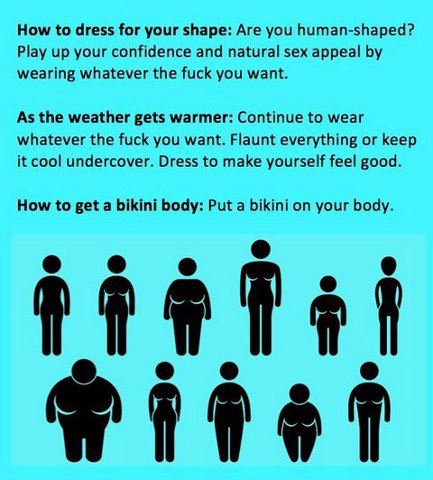
There is no specific “bikini body” you need to craft for the warm months. We all live in a natural state of bikini bodyism.

Really, this graphic (that I unfortunately can’t find a proper source for) sums up this whole post.

I'll also leave you with these tweets.


Stay rad, pals.

Thursday, May 8, 2014

Stop Making Us Say "I Have a Boyfriend"

You may have been lucky enough to see this article floating around the internet recently. While I agree that there’s a major problem in the way women use having a boyfriend as an excuse to get a guy to back off, this article skeeves me out a lot and I’m going to tell you why.

First of all, it places the blame on women, saying that the solution is for us to stand up for ourselves and not use excuses that take the choice away from us. However, the point is that many guys won’t respect that choice. Not many girls use a boyfriend (real or fake) as a first resort. Usually a significant other is only brought up once the man has made it clear he won’t take a simple no for an answer. Yes, it’s a cheap way out, but it’s also not the woman’s fault.

The problem here is what the original quote says: men respect another man’s “ownership” (barf) more than a woman’s independent choice. We can say we’re not interested until the cows come home and many guys will keep persisting. It’s not a problem of women giving excuses, it’s a problem of men thinking that instead of “no” meaning “go away,” it means “try harder.” And they don’t learn this from women – most men already have this idea in their head the first time they get rejected – they learn it from society.

The whole “a woman has to belong to a man” idea inherent in this problem is so clearly a result of patriarchy, and it makes me incredibly uncomfortable to pin the blame on women. We’ve learned throughout our lives that men pose a danger to us. It’s completely understandable to take the easy way out when confronted with someone who won’t take no for an answer. It’s 100% OK to say/do whatever’s necessary to get away without confrontation when doing otherwise might put you in danger.

If you feel comfortable standing your ground and not using any excuses to reject a guy, that’s completely your choice and it’s a brave one. But it’s also ignorant to argue that that’s always a safe and reasonable option. Whether it’s because the man is intimidating and you’re scared of how he might react to blunt rejection or you just don’t want to deal with the confrontation, you shouldn’t feel guilty for using an escape method you know will work.

I’m not saying a collective movement to honest rejection wouldn’t change some people’s behavior, but the problem is bigger than the independent behavior of any man or woman. It’s a structural problem in the way we teach boys that “no” means “convince me.” It’s a problem in the way we teach men that persistence is romantic instead of inappropriate. It’s a problem in the way we perceive women’s decisions as weak and easily changed.

The problem is NOT that women are using excuses to escape uncomfortable situations in the only way we know will work.

So instead of telling women to fix the problem, I’m going to tell men to stop making this practice necessary. If a woman says any version of “no thanks, I’m not interested,” back the fuck off and respect her choice. When we stop needing to pretend to belong to someone else, that’s when I’ll stop saying “I have a boyfriend.”

((Oh hey, I remembered that I have a blog!))

Friday, February 21, 2014

All Opinions Are Created Equal (Or Not)

//TW for transphobic language toward the end//

We are all under a major misconception. I’m not sure how far this spreads, but I know it’s common with everyone I personally know and in internet discourse. This misconception is that all opinions are equal.

I can pretty much pinpoint when the idea started for me. In 2nd or 3rd grade, we learned the difference between fact and opinion. Something is a fact if it’s indisputable and/or observable. Something is an opinion if you could also say the opposite is true. We did examples like it’s a fact that marbles are round while purple is the best color is an opinion. Terms like “best” and “worst” were easy indicators of opinions. While this taught me that I couldn’t project my beliefs onto others or use them to generalize the feelings of everyone, it introduced a dichotomy that simply can’t be applied to larger issues.

We start learning in early elementary school that there are things that are inherently true and things that are true only in the context of our minds, but we don’t really learn how to let facts shape our opinions.  Nobody’s going to try to convince everyone else that purple is the best color because there’s no way to confirm that. Sure, you can list awesome things that are purple and try to conclude that it’s the best color, but you can do the same thing for every other color so chances are you’re not going to convince anyone. So this is how we learn to look at opinions: nobody can be “right” so all opinions are equal in their wrongness.

But is that really true?

Is an opinion based on both research and experience the same as an opinion based on moral beliefs? Do opinions that subjugate and oppress people have the same merit as ones that encourage the fight toward equality? Should these opinions really get equal support and respect?

I think opinions can be wrong.

I think people who are anti-choice are wrong. If your opinion is that abortion is wrong, you have every right to make the choice not to get one. But if you want to force other people to adhere to your morals, that’s wrong. If your opinion places you in a position to make decisions for other people, that’s wrong.

I think people who ignore and diminish gender and sexual identities are wrong. If your gender identity matches the one you were assigned at birth and you’ve only ever experienced heterosexual attraction, that’s cool. But if you try to erase the experiences and feelings that other people have just because you can’t empathize, that’s wrong.

If your opinion is that politics are a waste of time, that’s wrong. If you’re in a privileged position where you don’t have to politically fight for your rights and you don’t feel the need to fight for others’, that’s your decision. But don’t you dare tell me I’m wasting my time because I can’t ignore the inequality around me. Don’t tell me I shouldn’t be trying to make things better in whatever way I can. That’s wrong.

That being said, I think people who don’t fight for the rights of others are wrong. Thinking you deserve more than other people just because it was automatically granted to you is wrong. Thinking there’s some sort of natural selection process that resulted in getting you where you are is wrong.

More than anything, if your opinion is based on inaccurate information or denial of reality, it’s wrong. Just because you personally don’t encounter or observe racism doesn’t mean you can argue it doesn’t exist. Just because you personally prefer traditional gender roles doesn’t mean you can deny they have harmful impacts on our society.

Saying purple is the best color doesn’t significantly deny or erase the experiences of others, it just offers a different perspective. Saying a trans woman isn’t a real woman isn’t just a different perspective, it’s wrong. Saying that women shouldn’t be able to have as much sex as they want isn’t just a different belief, it’s harmful and it’s wrong.


So no, just because I can’t stop you from sharing your problematic thoughts with the world, it doesn’t mean I have to respect your sexist/racist/ableist/queerphobic/transphobic opinion.

And if you choose to defend that opinion, I definitely don’t have to respect you.

Stay rad, pals.

(Alright I took 2 weeks off because I just wasn't feeling the feminist passion burning, but it's back! However, I think I'm gonna scrap the whole Monday/Thursday schedule and instead just post when I feel like I actually have something to say. That way I won't be forcing or rushing anything. I'm still gonna aim for twice a week but we'll see how that goes.)

Thursday, February 6, 2014

The Feminist Label AKA We’re (Mostly) Not About Burning Bras

Alright, friends, I’ve been wanting to talk about this for a while and the time has finally come. We need to stop being afraid to use the word feminist. Furthermore, we need to stop being afraid to use it as a label for ourselves. Not convinced? That’s because I’ve only written 3 sentences. Let me thoroughly convince you.
So feminism. Do we know what that means? I’m not trying to be a condescending piece of poopoo, I’m just guessing that many people don’t. It’s literally all about gender equality. Some people contest the name because they say it makes it seem completely focused on women. There is definitely an emphasis on women (as the disadvantaged group here), but we’re all about helping out the dudes as well. If you’re doing feminism the non-douchey way, we’re also looking out for trans people, genderfluid, genderqueer, two-spirit, and any other gender identity out there. Because the point is that we’re all human and gender shouldn’t have an inherent value placed on it.
Alright, we’ve established the cause as what I think most people would consider a worthwhile one. And yet only 26% of people say that feminist is a positive term. Let’s talk about misconceptions. Burning bras? I know I’m not the first one to make this point, but anyone who has ever browsed Victoria’s Secret knows how expensive bras are. I may be a raging feminist, but I’m not dumb enough to burn $40 worth of fabric.
We’re often categorized as man-haters. I can tell you that personally, I do not hate men at all. I consider myself a huge fan of men. Especially when they wear khaki pants or drive cars or have those veins sticking out of their arms that should really gross me out but I actually find it super attractive. I digress. We don’t hate men! We’re not particularly fond of men who want to have a say in something they’ll never actually experience. We may even dislike men who use their automatic higher status as a platform to drown out the voices of members of oppressed groups. But we don’t hate men based on the fact that they’re men. We hate the privilege that society automatically hands to them.
A lot of people like to call us lesbians. This probably follows the idea that if we hate men, we obviously need to find someone to have sex with (shout out to asexuality, amirite?) My response to this would be that if there seems to be a concentrated number of queer women in the world of feminism, it probably has something to do with their intersecting identities. Queer people are obviously oppressed by our society, mix that with the disadvantages of being a woman and you’ve probably created a human who’s willing to fight for equality. In my textbook that I’m not allowed to cite because it’s not technically published yet, the authors talk about patriarchal bargains and how many gay men negotiate the patriarchy (which would ostracize them for their sexuality) by emphasizing their manliness. Lesbian women don’t have that option. There’s my statistic-lacking theory.
Alright so you agree with the idea of gender equality. I feel safe assuming this because if you didn’t, you would’ve already left this page. What do you have to do to become a feminist? Call yourself a feminist. That’s it. There’s no set of expectations you need to meet to earn the label. Something like 88% of women want gender equality, yet only 23% identify as feminists. And only 16% of men accept the label. If you believe in gender equality (for ALL genders, remember. Not just men and women. Fuck the binary.) then you align with the feminist cause and therefore can call yourself a feminist.
What next, though? I have some suggestions for you. Baby steps are obviously fine, but also keep in mind that addressing gender inequalities is a constant learning experience. I can say from experience that each day I realize a new way that gender impacts my life. From the political aspect, bills are almost constantly being drafted, proposed, voted on, and passed that are meant to target a specific gender. You can’t just do an hour’s research and then consider yourself knowledgeable. If you want to be an active fighter for gender equality, you have to practice CONSTANT VIGILENCE. (Harry Potter, anyone?)
So my first suggestion is to Google (or use the search engine of your choice) rape culture. I think it was one of the topics that did the most to bring me into the cause. It’s something that you don’t necessarily realize until you suddenly see its effects everywhere.
Please, please, please, look up information about abortion. One of the quickest ways to alienate yourself from other feminists is to claim to be pro-life. I was there at one point. Make a list of the reasons you’re against abortion and then do some research. I found, and you probably will too, that most of my arguments were actually not based in fact at all. Look up the pro-life movement and the things it’s responsible for. More than anything, remember that pro-life isn’t about stopping abortion, it’s about blocking a woman’s safe and convenient access to abortion and inhibiting her choices.
Think about the ways that gender affects you in your daily life. As a man, that means acknowledging the privileges you have as well as the obstacles you encounter. Think about the double standard of sexual expression. (Have I talked about slut shaming yet? I definitely will.)
But overall, do not be afraid to call yourself a feminist. As the great Albus Dumbledore once said, “Fear of the name increases fear of the thing itself.” (Two HP references in one blog post, holla!) Show people that feminists and therefore feminism aren’t things to be scared of. Let’s get rid of the dumb stigma surrounding a worthy cause and then we can all happily wear witty t-shirts advertising our feminism.

Stay rad, pals.

Monday, February 3, 2014

Death is Weird

Recently, the film industry lost the talent of Philip Seymour Hoffman. I’m not going to pretend I’m super familiar with his acting career, but the films I did see him in gave me a respect and appreciation for his talent. I wouldn’t consider myself a fan and I definitely never knew the man personally, but I still feel a sense of loss.
As with the passing of Paul Walker and Cory Monteith in the last year, people on social media and in your day-to-day life are going to criticize those who mourn a celebrity’s death. They’ll say that just because someone’s famous doesn’t mean their death is any more tragic than the other thousands of deaths each day. I’m not here to say that they’re wrong.
But when you can put a name to a death, it’s going to feel more real than just hearing someone somewhere in the world died.
If you can put a face to that name, it’s going to affect you a little more.
If you know the cause of death, chances are you’re going to feel some sort of emotional connection.
If you are aware of the accomplishments in that person’s life, you’ll be able to recognize the world’s loss.
If you witnessed any of those accomplishments, you’ll probably feel your own sense of loss.
Maybe you feel some of these things, or maybe you recognize that death is sad but it’s also inevitable. That’s okay. If someone’s trying to tell you how you’re allowed to feel, they probably deserve a punch or two.
The truth of the matter is addiction is a serious issue. It’s something a lot of people struggle with, something with a deep social stigma surrounding it, and it kills a lot of people. Maybe someone sees a friend or a brother or even their future self in PSH’s death. Don’t tell them they can’t grieve.
Philip Seymour Hoffman is outlived by a partner and three children. Don’t tell someone they can’t feel sorry for the kids growing up without their father.
Some people just have problems confronting the reality of death.
Nobody should be demanding that you feel the same about every death you encounter in your lifetime. We’re all going through different stuff in our lives and nobody has any place to claim to understand or try to police another person’s feelings.
Whether you recognize this death as a loss of talent, a man who will be greatly missed, or just another part of the circle of life, you are completely entitled to those feelings.

Stay rad, pals, and R.I.P. Philip Seymour Hoffman.

Thursday, January 30, 2014

Thoughts on the State of the Union Address

First and foremost, I love Barack Obama so much it’s disgusting. He’s just a superb guy who I feel like believes a lot in the people of America, not just the country itself.
And, for the record, these are just my thoughts. I’ve done ZERO special research for this. I literally just watched the address and read people’s tweets about it and now I’m giving my reflection.
As you may have heard, Joe Biden is a true sight to behold. He has perfected his way of looking totally entranced by a speaker and it’s truly amazing. You can really feel what he feels while he listens. And don’t get me started on that pearly white smile. How can you disagree with anything that makes this man happy? I will never understand.
I have a lot of thoughts about John Boehner, mostly revolving around the fact that he’s an asshole. He also looks like a basset hound, perpetually sad and bored. He looked like he was working on his plot to overtake Obama’s presidency through the whole speech, only clapping when he realized everyone else was. And trust me, I hate standing ovations as much as the next person, but how many times did Joe Biden stand up while Boehner remained unmoved? I’m not sure the exact number, but it was quite a few.
There are few things I appreciate more than digs at people who don’t support the ACA, especially when they acknowledge the ridiculous amount of time Congress spent voting to repeal it and continuously failing. That happened during the SOTU so I was very pleased.
Obviously I’m also really hopeful about the policies that the president talked about. Raising minimum wage over $10 would be super awesome if it actually happens! So will an improved immigration system! Better student loans! Marriage equality! Access for women to reproductive health care! I can imagine people are criticizing the speech for being too focused on aspirations instead of hard set plans, especially since Obama has a terrible reputation for not getting anything done. But if you don’t think a lot of that has to do with an uncooperative Congress, I don’t know what to say to you. (Remember that ridiculous amount of votes to repeal Obamacare I talked about? Yeah.) Even so, he said this year he’s going to do everything in his power to get things done, even without help from Congress.
Overall, I just really like federal-level political events. I like bonding with other people who care about politics as much as I do. I like hearing hopeful messages of what our country might be if we work toward a goal. I like hearing concrete plans to achieve that goal. So the 2014 State of the Union gets an A+ for being everything I could dream of.

Stay rad, pals.